When you buy through links on our articles, Future and its syndication partners may earn a commission.

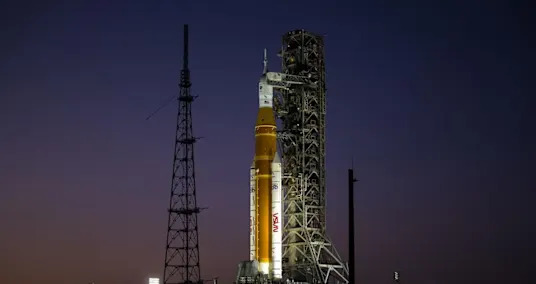
Artemis 2 is an ambitious mission, sending four astronauts on a 10-day loop around the moon and back to Earth. But it's not too ambitious: The quartet won't touch down on the lunar surface.
Artemis 2, which could launch as soon as April 1, consists of NASA astronauts Reid Wiseman (commander), Victor Glover (pilot) and Christina Koch (mission specialist), and Canadian Space Agency astronaut and mission specialist Jeremy Hansen.
Glover will be the first Black astronaut ever to fly a moon mission, while Koch will be the first woman and Hansen the first non-American to do so. They will become the humans to visit the moon's neighborhood since Apollo 17 did so in 1972.
Why no moon landing on Artemis 2?
The first moon landing of the Artemis program is expected to take place on Artemis 4, no earlier than 2028. That's because, simply put, the Artemis program isn't built to put Artemis 2 on the moon. The Orion spacecraft the astronauts will use has no landing capability, and NASA is taking a staged testing approach before committing to a moon landing.
Artemis 1 successfully sent an uncrewed Orion spacecraft to lunar orbit and back in late 2022, on the first-ever launch of the Space Launch System (SLS) rocket. It was the second mission for Orion, which had launched on a United Launch Alliance Delta IV on an uncrewed Earth-circling trip in December 2014.
Artemis 2 is also a test mission to the moon, but this time with crew. Orion will carry life-support systems for the first time, and the crew will test their ability to maneuver the capsule in Earth orbit before committing to an engine burn to reach the moon.
Artemis 2 "will confirm all the spacecraft’s systems operate as designed with crew aboard in the actual environment of deep space," NASA wrote in a mission description. "The mission will pave the way for lunar surface missions, establishing long-term lunar science and exploration capabilities and inspire the next generation of explorers."
NASA originally planned for Artemis 3 to make the program's first crewed lunar landing in 2027. In late February of this year, however, the agency restructured the Artemis program, changing Artemis 3 to a mission that will practice docking and rendezvous operations in Earth orbit between Orion and one or both of the program's private crewed landers (SpaceX's Starship and Blue Origin's Blue Moon). If all goes well with Artemis 3, Artemis 4 will put boots on the moon in 2028.
The eventual goal of the greater Artemis program is twofold: to establish a sustainable presence on the moon's surface and to demonstrate U.S. norms in cislunar space through the Artemis Accords (which is also framed as a race against China to the surface).
From 2024 to 2028
Long-time followers of Artemis may remember that the initial moon-landing deadline was 2024. That was set in March 2019, when then-U.S. Vice President Mike Pence announced the formation of the Artemis program. To be sure, the announcement built on previous work: many elements of Artemis (including Orion and SLS) predate the formation of the program by many years, and President Donald Trump made a crewed lunar return the official policy of the United States in December 2017 with the signing of Space Policy Directive 1.
In December 2019, a new senior NASA manager of the time showed off a "d-minus pin," which he made himself, showing that 1,855 days were left until Dec. 31, 2024. His intent was to update it daily and to wear it prominently during visits with the NASA workforce. That manager, Douglas Loverro, associate administrator for NASA's Human Exploration and Operations Mission Directorate, added that he did not want to "go ahead and tell people to rush" but instead wished to remind people to "make every day count."
By March 2021, however, NASA's Office of the Inspector General said it was "not feasible" to land humans on the moon by 2024 due to delays with developing the next generation of moon spacesuits, called the Exploration Extravehicular Mobility Unit (xEMU). (NASA later pivoted to a commercial solution from Axiom Space, which is still under development.)
Later in 2021, official aims of meeting the ambitious 2024 date quickly faded as space policy experts reflected on the beginning of the Biden administration. "Candidly, I don't think anyone thought that 2024 timeline was realistic. It was ambitious and aspirational, but I don't think realistic," Eric Stallmer, who had recently left his long-standing post as president of the Commercial Spaceflight Federation, told Space.com at the time.
Today, under the second Trump administration, the landing of Artemis 4 is set for 2028. Why is it still two years away? The spacesuit delays aren't the only factor; the human landing system and Orion's heat shield have also played a role.

Human landing system
In April 2021, SpaceX was awarded a sole-source contract by NASA, valued at $2.9 billion, to use Starship for the Artemis 3 landing. Three companies had competed for the opportunity, and it was widely expected that NASA would choose multiple vendors.
Competitors Blue Origin and Dynetics filed protests with the Government Accountability Office, with billionaire Jeff Bezos of Blue Origin promising to cover up to $2 billion in payments that the company might receive from NASA for the contract, among other things. Both protests were ultimately denied. Blue Origin then filed a lawsuit, which it lost in federal court.
NASA was later directed by the Senate Appropriations Committee to find a second HLS vendor, which ended up being Blue Origin in May 2023. The company got an award worth $3.4 billion and was expected to start landing NASA astronauts on the moon on the Artemis 5 mission.
Meanwhile, Starship's first fully stacked flight test took place in April 2023, which planned to fly the upper stage almost all of the way around Earth and end with a splashdown off Hawaii. But after the two stages of the vehicle didn't separate as expected, SpaceX made a controlled destruction of Starship over the Gulf of Mexico before the flight had reached four minutes of air time.
Also in 2023, NASA's Office of Inspector General (OIG) said that Starship development issues would likely push back the moon landing two years to 2026, and NASA also made a series of declarations saying it was worried about Starship's progress: "If you figure they need a number of launches to do their depot for our crewed flight, they need a number of launches to do the demo, they need a number of launches just to get flying — they have a significant number of launches to go, and that of course gives me concern," said Jim Free, NASA's associate administrator for exploration systems development, in one example from June 2023.
Starship has made considerable progress since then. In 2025 alone, SpaceX achieved five test flights. The first three didn't meet all goals, but SpaceX declared the August and October missions full successes. On both occasions, the Ship upper stage survived its trip to suborbital space and back to Earth for a splashdown off the coast of Western Australia, while the Super Heavy booster made a pinpoint landing in the Gulf of Mexico.
But that wasn't enough for Acting NASA Administrator Sean Duffy. In October 2025, he threatened to open the Starship first-landing contract (which at that time was still for Artemis 3) to other companies. "I love SpaceX; it's an amazing company. The problem is, they're behind. They've pushed their timelines out, and we're in a race against China," Duffy said on CNBC's "Squawk Box." =
Days later, SpaceX released a "simplified" Artemis 3 architecture proposal to speed up the work. And by early 2026, SpaceX CEO Elon Musk leaned harder into moon work, with a proposal to put a city on the lunar surface — a milestone that, of course, depends on the successful operation of Starship. Meanwhile, competitor Blue Origin put its New Shepard suborbital launch and space tourism program on hold for at least two years to pour more resources into lunar missions, presumably to help make its case to be called upon by NASA.
The Orion heat shield
The Artemis 1 mission of late 2022 achieved its major goals, but it also uncovered a major concern: By early 2023, NASA was noting that Orion's heat shield lost more material than expected during the high-speed reentry from the moon. The agency pledged to investigate the cause and to resolve it.
In May 2024, the OIG released a report about the issue, showing that Artemis 1 "revealed anomalies with the Orion heat shield, separation bolts and power distribution that pose significant risks to the safety of the crew." One key finding was that NASA uncovered more than 100 areas on Orion's heat shield that had ablated "differently than expected."
In December 2024, NASA officials elected to push back the Artemis 2 and Artemis 3 target launch dates to 2026 and 2027, respectively, to give themselves the room they needed to investigate the issue. The agency has also decided to fly a different reentry profile with Artemis 2 rather than replace the heat shield. NASA has said that it "can keep the crew safe during the planned mission, with changes to Orion's trajectory."
Readying for Artemis 3 and Artemis 4
The agency will evaluate the results of the Artemis 2 mission, after it flies, to inform the development of Artemis 3 and Artemis 4. But as things stand now, NASA plans to launch Artemis 3 in 2027 and Artemis 4 in 2028.
Both of those missions will require at least one of the two private lunar landers to be ready. Notably, an internal SpaceX document obtained by Politico in November 2025 showed that the company expects a September 2028 astronaut landing after achieving two major Starship testing milestones for the flight: June 2026 for the first orbital refueling demonstration between Starship vehicles, and an uncrewed lunar landing in June 2027.
A space-focused executive order from the Trump administration in December 2025 also acknowledged the updated timeline, in part directing "returning Americans to the moon by 2028 through the Artemis program."
New NASA Administrator Jared Isaacman, in comments published Feb. 10 in Aerospace America, said that he wants a crewed Artemis moon landing to happen as soon as possible. But he noted the importance of on-orbit propellant transfer operations being achieved as one key milestone ahead of that landing. Isaacman also has committed to "absolute needle-moving objectives" intended to spur the workforce, with a new workforce directive aiming to consider creating more civil service positions if needed to meet NASA's goals.
LATEST POSTS
- 1
 Shah Capital pushes for Novavax sale, warns of proxy fight
 - 2Go on A Careful spending plan: Modest Objections for Your List of must-dos
- 3Share your number one city visit transport that leaves a mark on the world wake up!
- 4Rediscovering Euphoria: Individual Accounts of Conquering Despondency
- 5EU Commission slams Israel's death penalty law for Palestinians



- Bird flu poses risk of pandemic worse than COVID, France's Institut Pasteur says
- Nearly half of reindeer have been wiped out and armadillos are in Iowa. Here’s how animals are weathering warming holidays
- 7 Peculiar Ways Of starting Your Imagination: Motivation Has Never Been This Good times
- How HIV/AIDS got its name − the words Americans used for the crisis were steeped in science, stigma and religious language
- Doritos and Cheetos dial back the bright orange in new versions without artificial ingredients
- Falcon 9 rocket launches Starlink satellites before making 550th SpaceX landing (video)
- JW Marriott Tokyo: an elegant retreat amid whirlwind of the city
- Zendaya serves bridal-coded fashion with old, new and borrowed gowns for ‘The Drama’ press tour
- Venezuelans in Madrid celebrate Maduro's capture